
Hormonal disorders
We look for the cause of your hormonal disorder – with a thorough hormone analysis and a treatment that suits you.

Diagnostics · Laboratory & hormone analysis
Understanding values. Recognising connections.
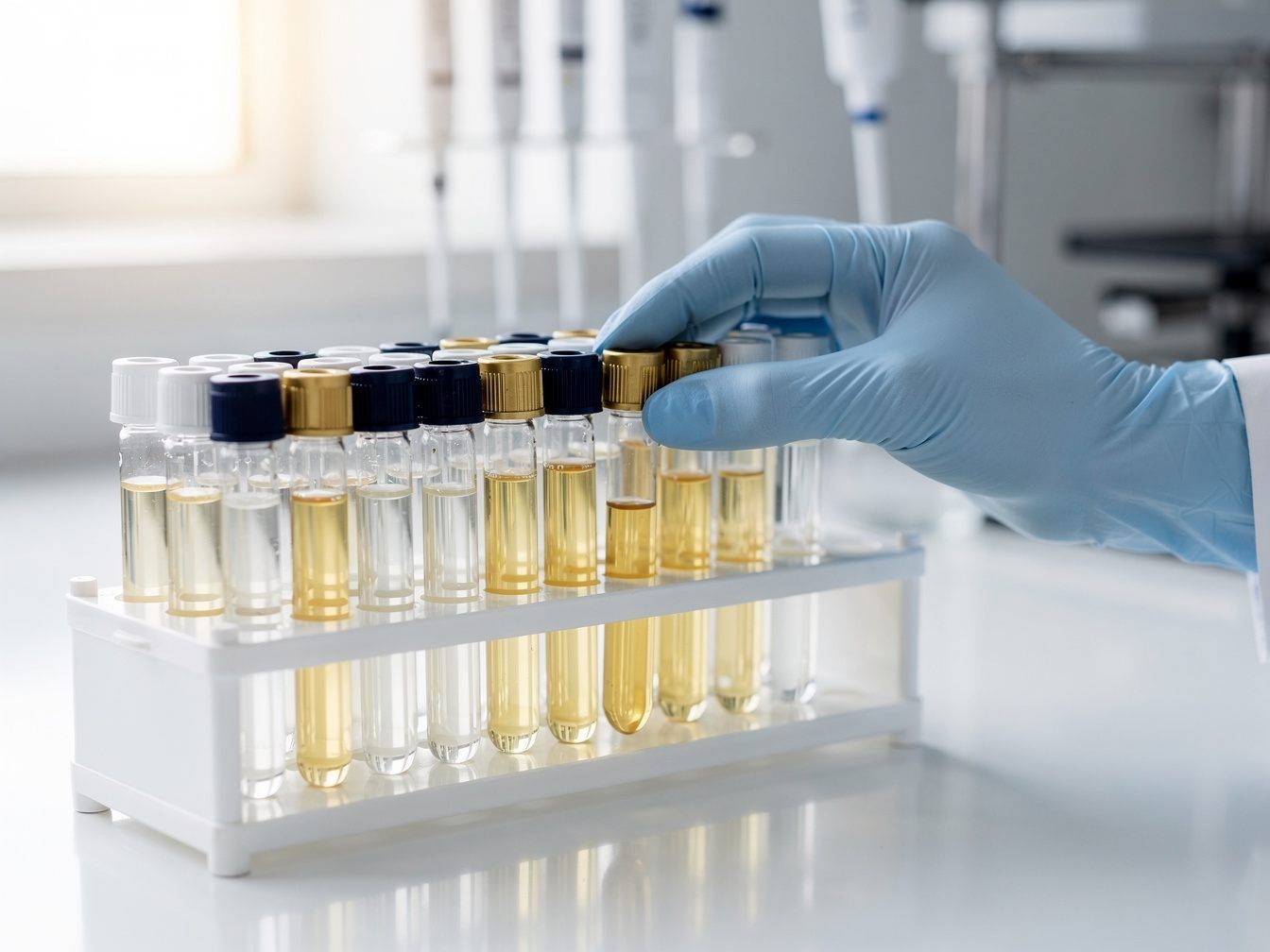
Many women's symptoms have causes that cannot be seen from the outside: hormones, the thyroid, vitamins or environmental exposures. With laboratory tests, hormone analysis and private laboratory tests, we clarify these connections in a targeted way. We place every value in the context of your history and explain it to you clearly.
When to come to us
You are constantly tired, lacking energy or unable to concentrate, and so far no one has found an explanation.
Irregular bleeding, premenstrual symptoms, menopausal symptoms or an unfulfilled wish for a child raise questions about your hormone balance.
You suspect a thyroid disease such as Hashimoto's – an inflammation of the thyroid caused by your own immune system – or would like known values rechecked.
You are wondering whether pollutants, heavy metals or a lack of vitamins and micronutrients could be behind your symptoms.
Our approach
For us, laboratory values are not an end in themselves. First we take time for your history and your symptoms. Then we choose together the values that make sense for your question. We look at hormones, thyroid, immune system, metabolism and possible environmental exposures in context. In this way we look for causes rather than just individual abnormal values. On this basis an individual treatment plan is developed – conventional, naturopathic or both together. Follow-up checks show how your values develop.
Not every laboratory test on offer makes sense for every woman; we measure only what is medically justified, and discuss benefits and costs openly with you.
Careful and personal
Depending on the question, we measure sex hormones such as oestrogens, progesterone and testosterone, pituitary hormones such as FSH and LH, and the adrenal hormone DHEA.
The control hormone TSH and the thyroid hormones show how your thyroid is working. Certain antibodies give indications of Hashimoto's.
Values such as vitamin D, vitamin B12, iron, selenium or zinc can show whether your body is lacking important building blocks.
If environmental exposure is suspected, heavy metals or other pollutants can be measured, for example. We interpret the results from an environmental medicine perspective.
If allergies or intolerances are suspected, IgE and IgG antibodies can be measured. We discuss the interpretation with you in detail.
Beyond the services covered by health insurance, extended tests in a private laboratory are possible when a closer work-up makes sense.
From research
Over more than four decades, more than 400 scientific publications have been written – on gynaecology, oncology, environmental medicine, hormones, immunology and naturopathy. This knowledge informs every consultation with your gynaecologist in Munich.
Schilddrüsen-Dysfunktion durch Parfüm ? Z. Prävention und Rehabilitation, Jahrgang 30 (2018)- 2.Quartal (S. 73-80)
Umweltmedizinische Aspekte der Frauenheilkunde, Teil 1: Grundlagen, Diagnostik, Beispiele, CO’MED, März 2016, S. 48-51
Prävention des Mammakarzinoms – endokrinologische und toxikologische Aspekte. Die Rolle von Östrogendominanz, Schilddrüsenunterfunktion, Morbus Hashimoto, NNR-Schwäche, Progesteron- und Insulinresistenz – mögliche Effekte endokriner Disruptoren, Prävention und Rehabilitation, Jahrgang 27, Nr. 1/ 2015, S. 26–37
Endokrine Disruptoren, insbesondere Schwermetalle, in der Gynäkologischen Endokrinologie – Diagnostik, Therapie und Prävention, Workshop für Ärzt(inn)e(n), Medizinische Woche, Baden Baden, 11/ 2014
Is this right for me?
For acute severe symptoms such as a high fever, severe pain or heavy bleeding, the medical on-call service on 116 117 can help. In an emergency, dial 112. If laboratory values show an illness that needs specialist treatment, we will refer you to a suitable specialist.
In four steps
Call us on 089 299655 or book online via Doctolib. We will tell you whether you should come on an empty stomach.
After a detailed conversation, we select the values. If necessary, the timing of the blood draw depends on your cycle.
Once the results are available, we discuss them with you and develop an individual treatment plan.
We support you during treatment and monitor important values over time where that makes sense.
Transparent from the start
Statutory health insurance covers medically necessary laboratory tests for symptoms or to clarify an illness. Extended laboratory profiles, for example for micronutrients or environmental exposures, are usually self-pay services for patients with statutory health insurance, under the German fee schedule for doctors (GOÄ). With private insurance, reimbursement depends on your policy. Before the blood draw, we discuss which values make sense and what costs will arise.
What our patients say
“Wonderful doctor. I went there with my wife to accompany her because she was so terribly afraid. She says so herself too. He is very empathetic and gives you a great feeling of being in very, very good hands there. The team is lovely and …”
“Very friendly and competent team. I have been a patient for years and am very satisfied, especially with the immune infusions, particularly after past illnesses/operations.”
“I have been a patient of Prof. Dr. Schulte-Uebbing for many years and have always been treated very kindly and attentively. The staff are very friendly and the doctor is very competent. Prof. Dr. Schulte-Uebbing always takes time to treat me competently …”
Expertise, clearly explained
The background in detail – click to expand.
Many hormone values fluctuate. Oestrogens and progesterone change markedly over the course of the cycle: progesterone rises only after ovulation, in the second half of the cycle. Other values such as FSH and LH are often measured at the start of the cycle. During the menopause, hormones fluctuate particularly strongly, so a single value says little. The time of day, stress and hormonal contraception also affect the results. That is why we plan the timing of the blood draw with you. And we always look at laboratory values together with your symptoms, not as mere numbers.
The thyroid controls metabolism, energy and the sense of temperature. It also affects the cycle, fertility and mood. In Hashimoto's, the body's own immune system attacks the thyroid; over time an underactive thyroid can develop. Typical symptoms are tiredness, feeling cold, weight gain or cycle disorders. Prof. Schulte-Uebbing has worked extensively on Hashimoto's and its links to the hormone balance, for example in “Hashimoto's thyroiditis, oestrogen dominance and progesterone deficiency” (Journal of Naturopathic Physicians, 2012). In consultations we therefore consider the thyroid and the sex hormones together. This gives a more complete picture that serves as a basis for suitable treatment.
Vitamins, minerals and trace elements are building blocks for the immune system, hormones, nerves and bones. A deficiency can arise from diet, stage of life, stress or impaired absorption in the gut. It often shows itself through non-specific symptoms such as tiredness or susceptibility to infection. Vitamin D plays a special role here; Prof. Schulte-Uebbing described it in “Vitamin D: an important and interesting hormone” (Your Health, 2015). What matters: more is not automatically better; some substances can cause harm if overdosed. The aim is therefore to supplement in a targeted way, based on measured values, rather than across the board.
As a specialist in environmental medicine, Prof. Schulte-Uebbing pays attention to everyday exposures. These include heavy metals and hormonally active substances, so-called endocrine disruptors – such as plasticisers in plastics, fragrances or aluminium. According to current knowledge, they can interfere with the hormone balance. Not all of these substances can be measured well in the blood, and interpreting the values takes experience. That is why we also ask about your home, work, cosmetics and diet. On this topic, Prof. Schulte-Uebbing has presented, among other things, “Endocrine disruptors, especially heavy metals, in gynaecological endocrinology – diagnostics, treatment and prevention” (Medical Week Baden-Baden, 2014).
In an allergy, the body forms antibodies of the IgE type against substances that are actually harmless, such as pollen or animal hair. IgE values can show such sensitisations; whether they trigger symptoms only becomes clear in the context of your symptoms. IgG antibodies against foods mainly show what the body has come into contact with. Their informative value for intolerances is disputed among experts. We therefore measure both values only in a targeted way and interpret them together with your symptoms. You can read more about this on our page on allergies and intolerances.
Good questions. Clear answers.
Can't find your question? Give us a call – we will take the time.
That depends on the values. For some tests, for example of sugar or fat metabolism, you should be fasting. For many hormone values this is not necessary. Drinking water is generally allowed. We will tell you what applies to you when you make your appointment.
That depends on which hormones we are measuring. Some values are informative at the start of the cycle, progesterone by contrast in the second half. We plan the right appointment with you. If your cycle is irregular or your period has stopped, we adapt the approach individually.
Please never stop medication on your own. Hormonal contraception and hormone therapy affect many laboratory values. So please tell us what you take when you book your appointment. Together we decide which values are informative under these conditions and how to proceed.
Statutory health insurance covers medically necessary laboratory values when you have symptoms. Extended tests, for example for micronutrients or environmental exposures, are usually self-pay services for patients with statutory health insurance, under the German fee schedule for doctors (GOÄ). Patients with private health insurance receive reimbursement depending on their policy. Before the blood draw, we discuss what costs will arise.
That depends on the test. Many standard values are available quickly; special analyses in a private laboratory take longer. We agree with you at the blood draw how and when we will discuss the results together.
Not necessarily. Many values do not automatically mean more clarity; they can also cause uncertainty. We select values specifically according to your symptoms and your history. We provide only medically appropriate services – this applies to the laboratory too.
Yes, gladly. Please bring earlier laboratory results, doctors' letters and a list of your medications and supplements. This helps us avoid duplicate tests and recognise developments over time. We add any missing values in a targeted way.
We discuss the results with you in detail and develop an individual treatment plan. This might be, for example, natural hormone therapy, targeted supplementation of micronutrients, thyroid treatment or further diagnostics. Over time we monitor important values where that makes sense.
Where to read next
We look for the cause of your hormonal disorder – with a thorough hormone analysis and a treatment that suits you.
 Example image
We consider Hashimoto's disease together with the thyroid, hormones and the wish to have a child, and support you holistically.
We compensate for hormone deficiency with bioidentical hormones – individually planned, carefully weighed up and regularly monitored.
We are happy to be there for you too
Do you have unexplained symptoms and would like medical advice, or are you coming to us with an existing diagnosis? We warmly welcome you to our practice in the centre of Munich.