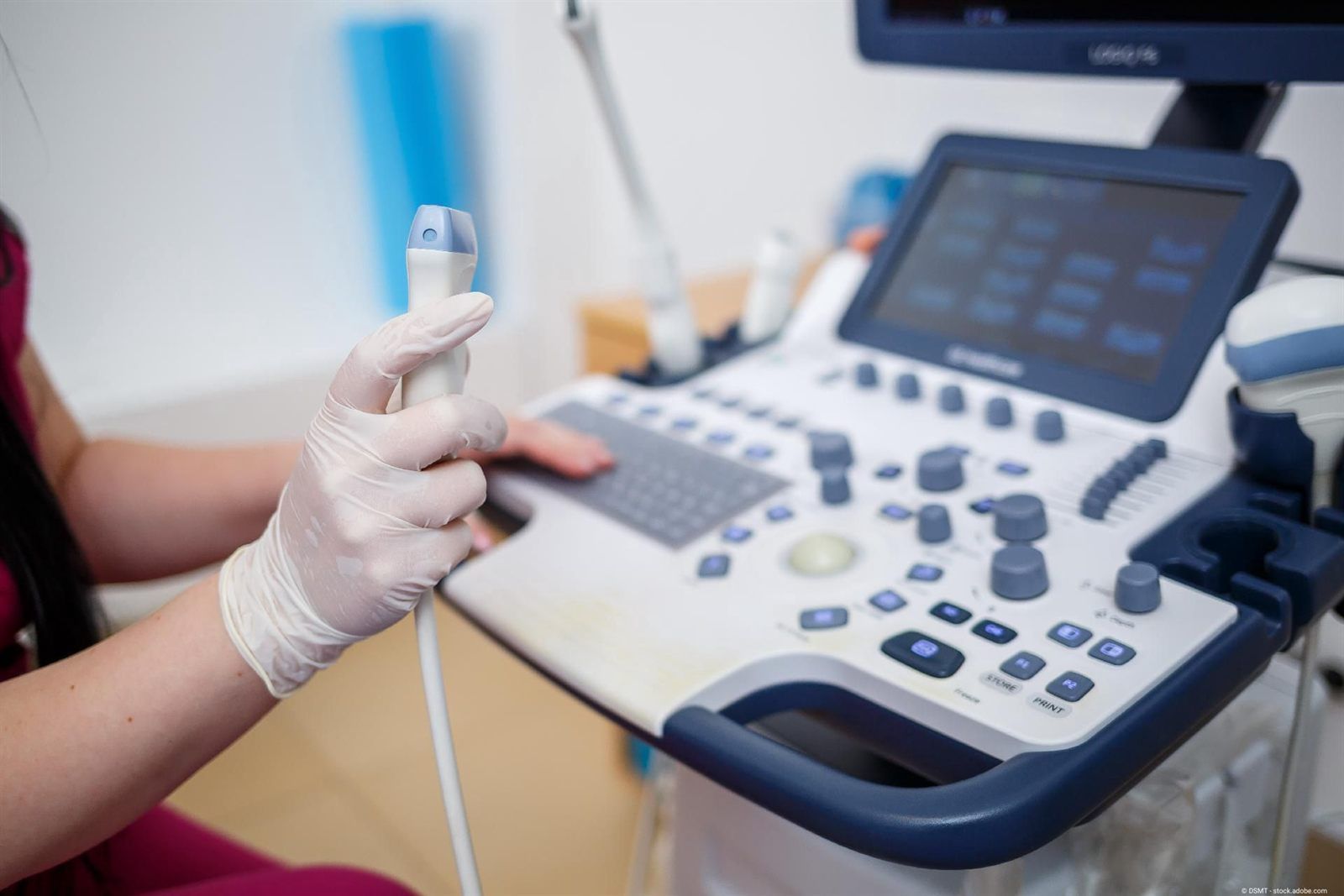
Ultrasound & 4D ultrasound
Ultrasound and 4D ultrasound show the uterus, ovaries and breast gently, without radiation and in real time.

Gynaecology · Fibroids
Investigate thoroughly, decide calmly.
Fibroids – benign nodules of muscle tissue in the uterus – often go unnoticed but can cause heavy bleeding, pain or pressure. At our practice in Munich, we investigate fibroids with ultrasound, look at your hormone balance and discuss honestly which approach suits you.

When to come to us
Your periods are very heavy or long, or you have bleeding between periods – sometimes with tiredness caused by iron deficiency.
You feel pressure in your lower abdomen, back pain, a frequent need to urinate or pain during sex.
A fibroid was found during an examination, and you would like to know what that means and whether you should do anything.
You would like to have a child and wonder whether a fibroid could affect pregnancy.
Our approach
Not every fibroid needs treatment. What matters is its size and position, your symptoms, your age and your life plans. We start with a careful ultrasound assessment and, if needed, check your blood count and hormone levels. Because fibroids grow under the influence of the sex hormones, we look at your hormone balance as a whole – including possible oestrogen dominance and environmental burdens. Alongside this, we offer holistic therapies such as acupuncture. If fibroids grow markedly or cause significant symptoms, we will tell you openly when an operation or another procedure may make sense.
We use naturopathic methods alongside conventional treatment, not as a replacement for treatment that is needed. That they shrink fibroids is not scientifically proven, and we will openly discuss when a different approach is needed.
Careful and personal
We determine the number, size and position of the fibroids with a vaginal ultrasound and record the findings for later comparison.
If bleeding is heavy, we check your blood count and iron levels. A hormone analysis shows how oestrogen and progesterone relate to each other.
We monitor small fibroids that cause no symptoms at sensible intervals. This lets us see in good time whether anything is changing.
For hormonal disorders, we discuss whether natural hormone therapy makes sense. With fibroids, we weigh this up carefully, because progesterone can also influence their growth.
We use acupuncture alongside conventional treatment for fibroid symptoms such as period pain. We advise on diet, weight and exercise, which all influence your hormone balance.
We explain the options – from uterus-preserving removal of fibroids to procedures without an incision – and support you before and after the procedure.
From research
Over more than four decades, more than 400 scientific publications have been written – on gynaecology, oncology, environmental medicine, hormones, immunology and naturopathy. This knowledge informs every consultation with your gynaecologist in Munich.
Hormonell wirksame Substanzen im Trinkwasser und deren Auswirkungen auf das Hormonsystem der Frau., gyn (23) 2018, S. 354-364
Prävention des Mammakarzinoms – endokrinologische und toxikologische Aspekte. Die Rolle von Östrogendominanz, Schilddrüsenunterfunktion, Morbus Hashimoto, NNR-Schwäche, Progesteron- und Insulinresistenz – mögliche Effekte endokriner Disruptoren, Prävention und Rehabilitation, Jahrgang 27, Nr. 1/ 2015, S. 26–37
Endokrinologische und Immunologische Aspekte der TWM (Traditionellen Westlichen Medizin): Phytosterine, P- Mangel, E- Dominanz, 8. Internationaler Hildegard- Kongress, Konzil Konstanz / Bodensee, 17. – 19. Oktober 2014
M. Hashimoto – Zunehmende Tendenz durch Umweltgifte ? Fördern Endokrine Disruptoren über Estrogen-Dominanz, Progesteron-Resistenz und Insulin-Resistenz M. Hashimoto und hormonabhängige Tumoren ? Zeitschrift Umwelt Medizin Gesellschaft 26, 4, 2013, S. 288-293
Is this right for me?
If you have very heavy bleeding with dizziness or circulatory problems, or sudden severe pain in your lower abdomen, please call 112; outside consultation hours, the on-call medical service is available on 116 117. If a fibroid grows quickly, especially after the menopause, have it investigated promptly.
In four steps
By phone on 089 299655 or online via Doctolib. Please feel free to bring any earlier ultrasound results with you – that way we can see whether anything has changed.
We ask about bleeding, pain and your life plans, and carry out a gynaecological examination with a vaginal ultrasound.
Together we weigh up the options: monitoring, holistic support, medication or a procedure. You help decide, calmly and well informed.
We monitor the fibroid at sensible intervals, adjust treatment as needed and support you around any procedure too.
Transparent from the start
Patients with statutory (GKV) or private health insurance are warmly welcome. Health insurers cover ultrasound for symptoms or to monitor a known fibroid, blood tests and guideline-based treatment. Acupuncture, extended hormone analyses and other naturopathic services are generally self-pay services under the German medical fee schedule (GOÄ). We will tell you before treatment what the costs will be.
What our patients say
“Competent doctor!”
“Absolutely recommendable! Both the professor and the staff are competent, kind and friendly.”
“Wonderful doctor. I went there with my wife to accompany her because she was so terribly afraid. She says so herself too. He is very empathetic and gives you a great feeling of being in very, very good hands there. The team is lovely and …”
Expertise, clearly explained
The background in detail – click to expand.
Fibroids are benign nodules made of muscle and connective tissue in the uterus. They occur in many women, especially in the years before the menopause. Fibroids can occur singly or in groups and vary greatly in size. Their position is often what determines the symptoms: subserosal fibroids grow on the outside of the uterus and sometimes press on the bladder or bowel. Intramural fibroids lie within the muscle wall. Submucosal fibroids bulge into the uterine cavity; they are more likely to cause heavy bleeding and can make implantation more difficult. Many fibroids cause no symptoms and are discovered by chance during an ultrasound scan. In that case, it is often enough to monitor them at sensible intervals.
Fibroids grow under the influence of the sex hormones oestrogen and progesterone. That is why they develop during the fertile years and usually shrink after the menopause. A hereditary predisposition also plays a role. In holistic gynaecology, people often speak of oestrogen dominance: an excess of oestrogen relative to progesterone, as can occur in the years before the menopause when ovulation becomes less frequent. Oestrogen dominance is not a diagnosis in its own right in conventional medicine, but an explanatory model. Prof. Schulte-Uebbing has worked on this for many years, for example in “Hashimoto's disease, progesterone deficiency, oestrogen dominance” (Menopause Congress, University of Vienna, 2012). For treatment, this means we look at your hormone balance as a whole, not just the fibroid.
Whether and to what extent environmental factors influence the growth of fibroids is still being researched. So-called endocrine disruptors are under discussion: substances from plastics, cosmetics, fragrances or drinking water that can act somewhat like oestrogen in the body. Prof. Schulte-Uebbing has done a great deal of scientific work on such substances, for example in “Hormonally active substances in drinking water and their effects on the female hormone system” (gyn, 2018; published in German). This is one reason why our practice is nicotine-free and perfume-free. In addition, body weight, exercise and diet affect your hormone balance, because fatty tissue produces oestrogen itself. We will advise you on what you can do in everyday life. We make no promise that fibroids will become smaller as a result.
Small fibroids that cause no symptoms are usually just monitored. If bleeding is heavy, medication can reduce it, and an iron deficiency is corrected. Hormonal medication can ease symptoms, and some types shrink fibroids temporarily, for instance before an operation. Fibroids can be removed surgically while preserving the uterus – depending on their position, by laparoscopy (keyhole surgery), hysteroscopy or open surgery. Once family planning is complete and symptoms are severe, removal of the uterus may also be an option. There are also procedures without an incision, such as embolisation, in which the blood vessels supplying the fibroid are closed off, or focused ultrasound. Which procedure suits you depends on size, position, symptoms and whether you wish to have a child.
Not every fibroid needs to be operated on. An operation or another procedure may make sense if heavy bleeding leads to anaemia despite treatment, if a fibroid presses noticeably on the bladder or bowel, if pain dominates your daily life or if a fibroid in the uterine cavity makes it harder to have a child. A fast-growing fibroid, especially after the menopause, should also be investigated more closely. We will tell you openly if we think a procedure makes sense, explain the options and risks and name suitable surgical centres. We continue to support you before and after the procedure. The decision is yours – made calmly and well informed.
Many women with fibroids become pregnant without any problems. However, fibroids that protrude into the uterine cavity can make implantation more difficult; in that case, removal before pregnancy may make sense. During pregnancy, fibroids can grow and cause symptoms. With the menopause, hormone levels fall and fibroids usually become smaller. If you have known fibroids, we weigh up hormone therapy during the menopause carefully and monitor it with ultrasound. If a fibroid grows after the menopause, we investigate this further promptly. That way, you and we can keep track of how things develop in every phase of life.
Good questions. Clear answers.
Can't find your question? Give us a call – we will take the time.
No. Many fibroids cause no symptoms and only need to be monitored. Treatment makes sense if bleeding, pain or pressure affects your everyday life, if the fibroid is growing quickly or if it stands in the way of a wish to have a child. We will discuss in detail what suits your situation.
Fibroids are benign. Malignant muscle tumours of the uterus are rare and, according to current knowledge, usually do not arise from an existing fibroid. Even so, a fast-growing nodule, especially after the menopause, should be investigated promptly. Regular ultrasound checks give you and us reassurance.
There is no reliable evidence for this. The aim of naturopathic methods, an adapted diet and exercise is to keep an eye on your hormone balance and to support you through symptoms such as period pain. We use them alongside conventional treatment and will tell you openly when a different approach is needed.
Yes, many women with fibroids become pregnant without any problems. Fibroids that protrude into the uterine cavity can make implantation more difficult. We use ultrasound to clarify whether a fibroid is relevant in your case. If needed, we discuss whether removal before pregnancy makes sense.
As hormone levels fall, fibroids usually shrink, and bleeding problems end with the final period. We weigh up hormone therapy during the menopause carefully when fibroids are present. If a fibroid grows after the menopause, we investigate this promptly.
That depends on its size and position, your symptoms and your age. We check a newly discovered fibroid more often at first, and one that has been stable for years less often. If you develop new symptoms or heavier bleeding, please come sooner. We will agree the right schedule together.
A vaginal ultrasound is usually brief and well tolerated by most women. Tell us if anything is uncomfortable – we will take your needs into account. For large fibroids, we sometimes add an ultrasound through the abdominal wall to see the full extent.
Health insurers cover ultrasound for symptoms or to monitor a known fibroid, blood tests and guideline-based treatment. Acupuncture, extended hormone analyses and other naturopathic services are usually self-pay services under the German medical fee schedule (GOÄ). We will tell you in advance what the costs will be.
Where to read next
Ultrasound and 4D ultrasound show the uterus, ovaries and breast gently, without radiation and in real time.

We compensate for hormone deficiency with bioidentical hormones – individually planned, carefully weighed up and regularly monitored.
 Example image
Endometriosis is a main focus of our practice: thorough diagnostics, guideline-based treatment and complementary naturopathy.
We are happy to be there for you too
Do you have unexplained symptoms and would like medical advice, or are you coming to us with an existing diagnosis? We warmly welcome you to our practice in the centre of Munich.