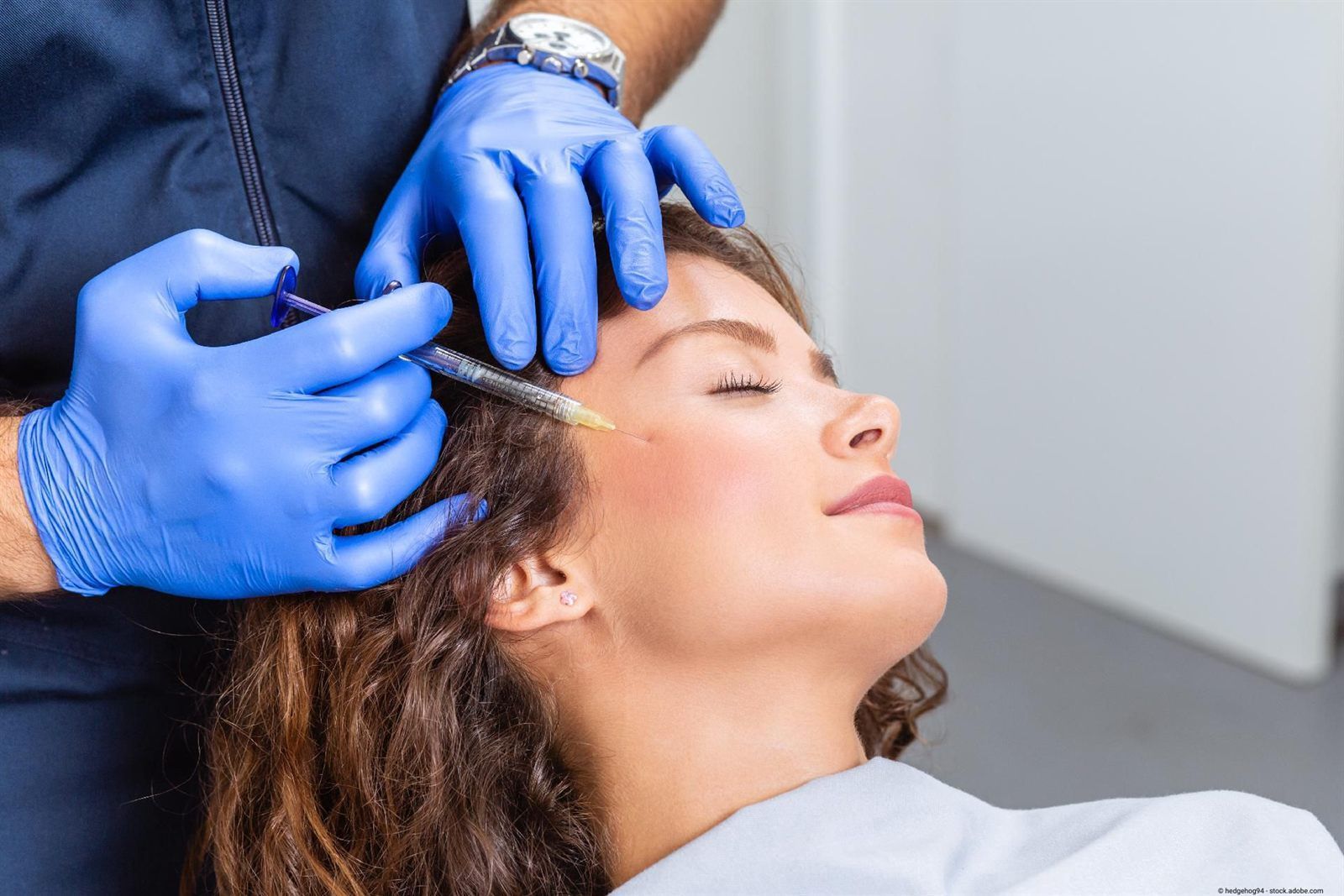
PRP for hair loss
We use platelet-rich plasma from your own blood as a complement for thinning hair – after the causes have been investigated.

Aesthetics & beauty · Hair loss in women
Investigate thoroughly. Treat in a targeted way.
Is your hair getting thinner, your parting wider, or are you suddenly losing a lot of hair? In women, hair loss can have causes in the body – hormones, thyroid, or a lack of iron and micronutrients. At our gynaecology practice in Munich, we investigate the causes thoroughly and support you alongside this with mesotherapy and PRP.
When to come to us
The parting becomes wider, the ponytail thinner, the scalp shows through more – often gradually over months.
In the brush, in the drain or on the pillow, you suddenly find markedly more hairs than usual.
A few months after childbirth, stopping the pill, an infection or severe stress, more hair falls out.
Alongside hair loss come tiredness, feeling cold, cycle disorders, blemished skin or menopausal symptoms – this may point to hormonal causes.
Our approach
Hair is a sensitive mirror of the body. That is why the search for the cause comes first with us. In a detailed conversation we ask about the course, cycle, pregnancies, contraception, medication, diet and stress. We look at the scalp and hair and, if needed, determine laboratory values, for example for the thyroid, iron stores, vitamins and hormones. If we find a treatable cause, such as a thyroid condition or a deficiency, we treat it in line with guidelines. As a complement, we offer mesotherapy and PRP on the scalp, with the aim of strengthening the hair roots and supporting natural hair growth.
Mesotherapy and PRP are complementary procedures whose effectiveness in hair loss has not been conclusively proven scientifically; they do not replace investigating and treating the cause, and whether and how much hair grows back is individual.
Careful and personal
A detailed conversation about course, cycle, stage of life, medication and diet; a look at the scalp, hair density and the distribution of hair loss.
Where needed, blood tests for the thyroid and thyroid antibodies, iron stores, vitamins, minerals and hormones, for example male hormones if PCOS is suspected.
If there is a cause, such as an underactive thyroid, an iron deficiency or a hormonal imbalance, we will discuss suitable therapy with you.
Fine injections of selected active ingredients into the scalp. The method is based on the idea of supplying the hair roots directly on site.
Platelet-rich plasma from your own blood is introduced into the scalp. The aim is to support the hair roots with the body's own growth factors.
Hair grows slowly. We support you over several months and assess together how your hair and laboratory values develop.
From research
Over more than four decades, more than 400 scientific publications have been written – on gynaecology, oncology, environmental medicine, hormones, immunology and naturopathy. This knowledge informs every consultation with your gynaecologist in Munich.
Was Sie über das „Anti Aging Hormon“ DHEA wissen sollten, Zeitschrift „Ihre Gesundheit“, Nr. 1, 2018, S. 8-12
Schilddrüsen-Dysfunktion durch Parfüm ? Z. Prävention und Rehabilitation, Jahrgang 30 (2018)- 2.Quartal (S. 73-80)
Wird die Hashimoto Thyreoiditis durch Endokrine Disruptoren (E D) im Trinkwasser gefördert? CO’Med, 2017
Integrative Intravenöse Lasertherapie zur Behandlung von Autoimmunerkrankungen am Beispiel des M. Hashimoto, 10. Internationaler Kongreß für Medizinische Laserapplikationen, Jubiläumskongreß Int. Soc. Med. Laser Application, Beverungen, 12.- 13. Juni 2015
Is this right for me?
If there are circular bald patches, inflammation, heavy flaking or scarring of the scalp, a dermatological investigation is needed first. We support hair loss during chemotherapy only in agreement with your treating oncologists. During pregnancy and breastfeeding, we do not carry out mesotherapy or PRP.
In four steps
By phone on 089 299655 or online via Doctolib. Please bring any existing laboratory results and a list of your medication.
We discuss the course and accompanying symptoms, look at your scalp and hair, and take blood for laboratory analysis if needed.
With the results we discuss possible causes and decide which therapy and which complementary procedures make sense for you.
We treat the cause, carry out mesotherapy or PRP in several sessions if you wish, and monitor progress over months.
Transparent from the start
Depending on your insurance status, we bill the consultation, examination and medically necessary laboratory values for investigating hair loss through statutory or private health insurance. Some extended laboratory tests are self-pay services. Mesotherapy and PRP on the scalp are generally self-pay services under the German fee schedule for doctors (GOÄ). We will tell you before examination and treatment what costs will arise.
What our patients say
“Wonderful doctor. I went there with my wife to accompany her because she was so terribly afraid. She says so herself too. He is very empathetic and gives you a great feeling of being in very, very good hands there. The team is lovely and …”
“Very friendly and competent team. I have been a patient for years and am very satisfied, especially with the immune infusions, particularly after past illnesses/operations.”
“I have been a patient of Prof. Dr. Schulte-Uebbing for many years and have always been treated very kindly and attentively. The staff are very friendly and the doctor is very competent. Prof. Dr. Schulte-Uebbing always takes time to treat me competently …”
Expertise, clearly explained
The background in detail – click to expand.
Every hair goes through a cycle: a long growth phase, a short transition phase and a resting phase, at the end of which it falls out and a new one grows. Losing a few hairs every day is therefore normal. We speak of hair loss when markedly more hairs fall out than grow back or the hair becomes visibly thinner. Two forms are particularly important in women: diffuse hair loss, in which many hairs move into the resting phase at the same time – often a few months after a trigger – and hormonal hereditary hair loss, in which the hair gradually becomes thinner, mainly at the parting. There are also forms such as alopecia areata (patchy hair loss), an autoimmune condition that belongs in the hands of a dermatologist.
Hormones help to control the hair cycle. Oestrogens lengthen the growth phase – which is why hair is often fuller during pregnancy and falls out more after childbirth. When the oestrogen level falls during the menopause or after stopping the pill, male hormones (androgens) can have a stronger effect. With a corresponding predisposition, the hair roots on the top of the head then become smaller and the hair thinner. An excess of androgens, for example in polycystic ovary syndrome (PCOS), can additionally lead to blemished skin, cycle disorders and increased hair growth on the face. As a gynaecology practice with a focus on hormones, we look at the hormonal balance as a whole; among other things, Prof. Schulte-Uebbing has published on progesterone deficiency and oestrogen dominance.
The thyroid influences metabolism, energy and also hair growth. Both an underactive and an overactive thyroid can trigger diffuse hair loss, often together with tiredness, dry skin, feeling cold or weight changes. In women, an underactive thyroid can be caused by Hashimoto's, an autoimmune inflammation of the thyroid. Prof. Schulte-Uebbing has worked on Hashimoto's disease for many years and has published numerous articles on it. For hair loss, we therefore determine thyroid values and thyroid antibodies where needed. If a condition is found, we treat it. Whether and how quickly the hair recovers afterwards is individual; it usually takes several months.
The cells of the hair root divide very quickly and therefore react sensitively to a deficiency. In women, iron deficiency is particularly significant, for example because of heavy periods, pregnancies or a diet low in meat. Empty iron stores can promote hair loss long before anaemia occurs. Vitamin D, zinc, biotin, protein and amino acids also play a role in hair growth; strict diets can trigger diffuse hair loss. Where needed, we determine the appropriate values. We correct a proven deficiency in a targeted way – not with a scattergun approach, because too much of some substances can also do harm.
In mesotherapy, small amounts of selected active ingredients are introduced into the scalp with very fine needles. The method is based on the idea of supplying the hair roots directly on site. In PRP, platelet-rich plasma, blood is drawn and processed so that the platelets, with their growth factors, are concentrated. This plasma is injected into the scalp; the aim is to strengthen the hair roots and support natural hair growth. Both procedures are applied in several sessions. Their effectiveness has not been scientifically proven for every form of hair loss. We use them as a complement, once the cause has been investigated, and discuss openly what you can expect.
Good questions. Clear answers.
Can't find your question? Give us a call – we will take the time.
Losing a few hairs every day is normal, because every hair falls out at the end of its cycle and is replaced. When washing or brushing, visibly more come away because loosened hairs come with them. It is noticeable if, over weeks, markedly more hairs fall out than usual, the parting becomes wider or bald patches appear. An investigation then makes sense.
That depends on your symptoms. A blood count, iron stores (ferritin), thyroid values and thyroid antibodies are often included, and depending on the situation also vitamin D, zinc and hormones such as male hormones or prolactin. We select the values in a targeted way and explain the results to you in the consultation.
That depends on the cause. In diffuse hair loss, for example after childbirth, an infection or a deficiency, the hair roots are usually not destroyed; once the trigger is resolved, the hair can grow back. In hormonal hereditary hair loss, the focus is more on slowing its progression. How your hair develops is individual and takes patience, because hair grows slowly.
Both procedures are applied in several sessions at intervals; afterwards, top-ups are possible if needed. How many sessions make sense depends on the type of hair loss, its course and your wishes. Because hair grows slowly, we assess progress with you over several months.
The injections are given with very fine needles. Many women feel them as a brief prick or burning sensation that is easy to tolerate; some areas of the scalp are more sensitive. Afterwards the scalp may be red or tender for a while. With PRP, a blood draw is added. We discuss beforehand whether cooling or local anaesthesia makes sense.
During the menopause the oestrogen level falls and male hormones gain relative influence. With a corresponding predisposition, the hair then becomes thinner, mainly on the top of the head. At this stage of life, thyroid conditions or an iron deficiency caused by irregular, heavy bleeding can also be added. As a gynaecology practice, we look at all of this together and also talk with you about natural hormone therapy.
Yes, this is common. During pregnancy, high oestrogen levels keep more hairs in the growth phase. After childbirth they move into the resting phase together and fall out a few months later. This usually resolves by itself. If the hair loss lasts a long time or tiredness and other symptoms are added, the thyroid and iron stores should be checked.
Depending on your insurance status, we bill the medical investigation – that is, the consultation, examination and necessary laboratory values – through your statutory or private health insurance. Mesotherapy and PRP on the scalp are generally self-pay services under the German fee schedule for doctors (GOÄ). We will tell you beforehand what costs will arise.
Where to read next
We use platelet-rich plasma from your own blood as a complement for thinning hair – after the causes have been investigated.
Mesotherapy delivers small amounts of selected active ingredients directly into the skin – for skin appearance, hair growth or pain.
 Example image
We consider Hashimoto's disease together with the thyroid, hormones and the wish to have a child, and support you holistically.
We are happy to be there for you too
Do you have unexplained symptoms and would like medical advice, or are you coming to us with an existing diagnosis? We warmly welcome you to our practice in the centre of Munich.